
5 Surprising Truths About the New Sony A7V (It’s Not What You Think)
The New Sony A7V (It’s Not What You Think) Know all 5 Surprising Truths about it
Every new camera launch is met with a tidal wave of hype, spec sheets, and marketing promises. But the numbers rarely tell the whole story. The real-world impact of a camera is found in the details that emerge from hands-on testing. The new Sony A7V is no exception. Early reviews are in, and beyond the expected iterative updates, they reveal a camera that is far more significant than its spec sheet suggests. Here are the five most surprising and impactful truths about the Sony A7V that you won’t find in the press release.
1. Sony A7V is a Flagship in Disguise
The most shocking revelation about the Sony A7V is how many professional-grade features it inherits directly from Sony’s top-tier A1 Mark II. This isn’t just a mid-range update; it’s a fundamental shift in what’s available at this price point.
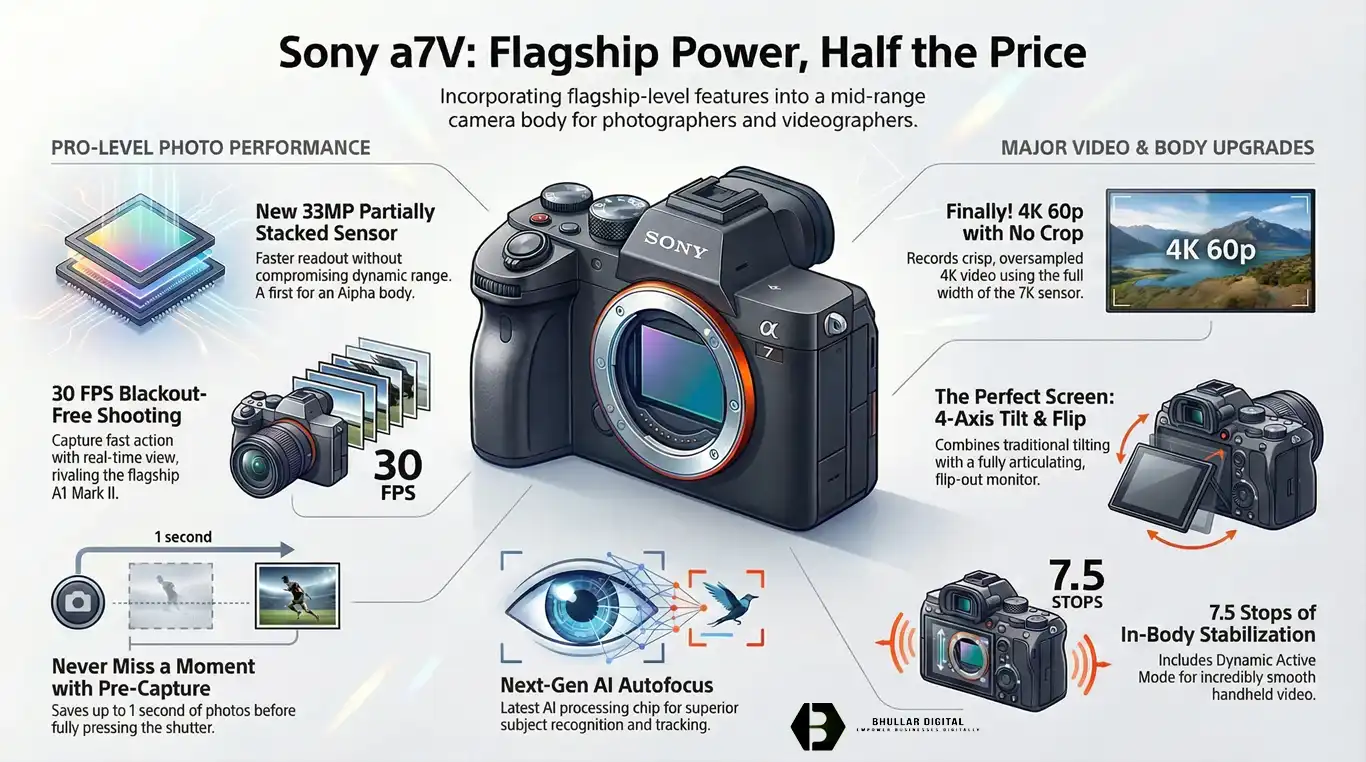
Specifically, the Sony A7V now boasts a 30 frames per second (fps) electronic burst shutter with zero blackout frames and the invaluable Pre-capture feature, which saves frames before you fully press the shutter. These capabilities, previously the exclusive domain of elite sports and wildlife cameras, give the A7V a level of speed and responsiveness that feels uncanny in a mid-range body. It effectively operates like a “baby A1 Mark II,” a camera that costs more than double.
As reviewer Jason Vong put it, this upgrade alone redefines the camera’s value proposition.
“this feature alone makes it dangerously close to a $7,000 flagship camera for half the cost”
There is one critical caveat, however. Vong notes that “in order to maximize the 30 frames per second you’ll likely need to use Sony lenses,” with third-party options being capped around 10 to 15 fps. It’s a key trade-off, but for those in the Sony ecosystem, bringing this unprecedented speed to the A7 series makes this camera what Vong calls a “whopping steal.”
2. The Sony A7V’s New Sensor Breaks the Rules
The Sony A7V is built around a brand new 33-megapixel “partially stacked sensor.” In simple terms, this technology enables dramatically faster sensor readout speeds, which is the key to reducing the image distortion (or “rolling shutter”) that can plague silent electronic shooting.
Here’s the counter-intuitive surprise: competitor cameras that have adopted similar technology have been forced to make a painful compromise, often sacrificing dynamic range—the ability to capture detail in the brightest highlights and darkest shadows. Mark Galer points to a stark example in the Nikon Z6III, which “is performing with less dynamic range than the previous Z62 model,” specifically “over a one and a half stops less dynamic range at ISO 400” with its electronic shutter.
The Sony A7V, however, does not make this trade-off. Sony claims the A7V has one extra stop of dynamic range, making it a “no compromise” sensor that delivers both speed and superior image quality. As Galer confirms:
“we are not going to compromise that dynamic range with the Sony model”
Achieving faster readout speeds while simultaneously improving dynamic range is a landmark achievement, delivering flagship performance without the typical flagship compromises.
3. The Great Screen Debate Is Finally Over
For years, a civil war has raged among content creators: photographers have largely preferred the speed and convenience of a traditional tilt screen, while videographers have demanded a fully articulating, flip-out screen for vlogging and varied camera angles.
The Sony A7V ends this debate decisively with its new 4-axis multi-angle LCD screen. This brilliant piece of engineering combines both mechanisms into one, allowing the screen to tilt up and down like a traditional screen and flip out to the side for full articulation. It is, quite literally, the best of both worlds.
The impact of this seemingly simple hardware update, as Jason Vong so bluntly puts it, cannot be overstated.
“…no more flip screen no more tilts debate you can tilt it you can flip it you can shut up now”
This is a massive quality-of-life improvement that makes the A7V dramatically more versatile for hybrid shooters. Whether you’re a photographer, a videographer, or both, the screen is finally designed to work exactly how you need it to, without argument.
4. It Has a ‘Secret’ Superpower in the Dark
For low-light video shooters, the A7V has an undocumented superpower: an apparent Dual Base ISO. This technology provides two native sensitivity points where the sensor produces its cleanest image, and testing from Think Media suggests the A7V has a second “clean” point around ISO 8,000 when shooting in S-Log 3, in addition to its standard base of 800.
The visual evidence is stunning. As the ISO is pushed past 6,400, noise becomes very apparent, but at ISO 8,000, the image noise “completely cleans up.” The result is remarkably clean and usable footage at levels as high as ISO 20,000. This “secret” superpower makes the A7V an unexpectedly formidable tool for anyone shooting video in challenging, dimly lit environments.
5. What It’s Missing Is a Feature, Not a Flaw
As with any new release, online forums are buzzing about the professional video features the A7V lacks, such as “Open Gate” recording (using the full sensor area for flexible cropping) and internal RAW video. However, a closer analysis suggests these omissions are not an oversight but a deliberate, strategic choice by Sony.
The logic is simple: Sony is carefully protecting its dedicated, higher-end cinema line. Features like Open Gate and internal RAW video are incredibly data-heavy and are hallmarks of professional cinema cameras like the A7S and FX series. The reason is practical: Jason Vong highlights the “insane file size that comes with it,” citing the new Canon R6 Mark III’s 7K RAW video, which requires approximately 10 GB per minute of storage. For most users, that workflow is unsustainable. By reserving these capabilities for its more expensive models, Sony maintains clear product segmentation.
Reviewer Jason Vong provides a clear-eyed analysis of this strategy:
“keep in mind this is a mid-range camera it’s not meant to have the newest cutting edge features until its bigger brothers do”
Therefore, the Sony A7V shouldn’t be seen as a camera that’s lacking. Instead, it should be understood as a powerfully focused hybrid tool that excels within its intended role, perfectly serving the needs of “broad content creators” who require a potent mix of high-end photo and video capabilities.
Conclusion
The Sony A7V is far more than an incremental upgrade. It is a strategic and surprisingly aggressive release that blurs the lines between product categories. By democratizing the A1 Mark II’s speed while simultaneously solving the sensor compromise that plagues competitors like Nikon, Sony is actively redefining the “mid-range” category. It has created a camera that delivers flagship-level performance and thoughtful quality-of-life improvements without asking users to accept the usual trade-offs.
When a mid-range camera can do this much, what does the “pro” label even mean anymore?
Well Interested to know more about the Sony A7V and it’s current price Click Here
Also read our explore section